For the last several months I’ve been scanning my father’s 35mm slides — and enjoying every bit of it. Kodak Kodachrome and Ektachrome, roughly 1958 through the late 1980s, one cardboard mount at a time. The volume is impressive — tray after tray, decades of family and travel. Dust, scratches, and faded film come with the territory. Skies that went cyan. Reds that gave up. A lot of the older ones need real restoration before they look like the day he pressed the shutter. That part is work. I’m glad he shot so much.
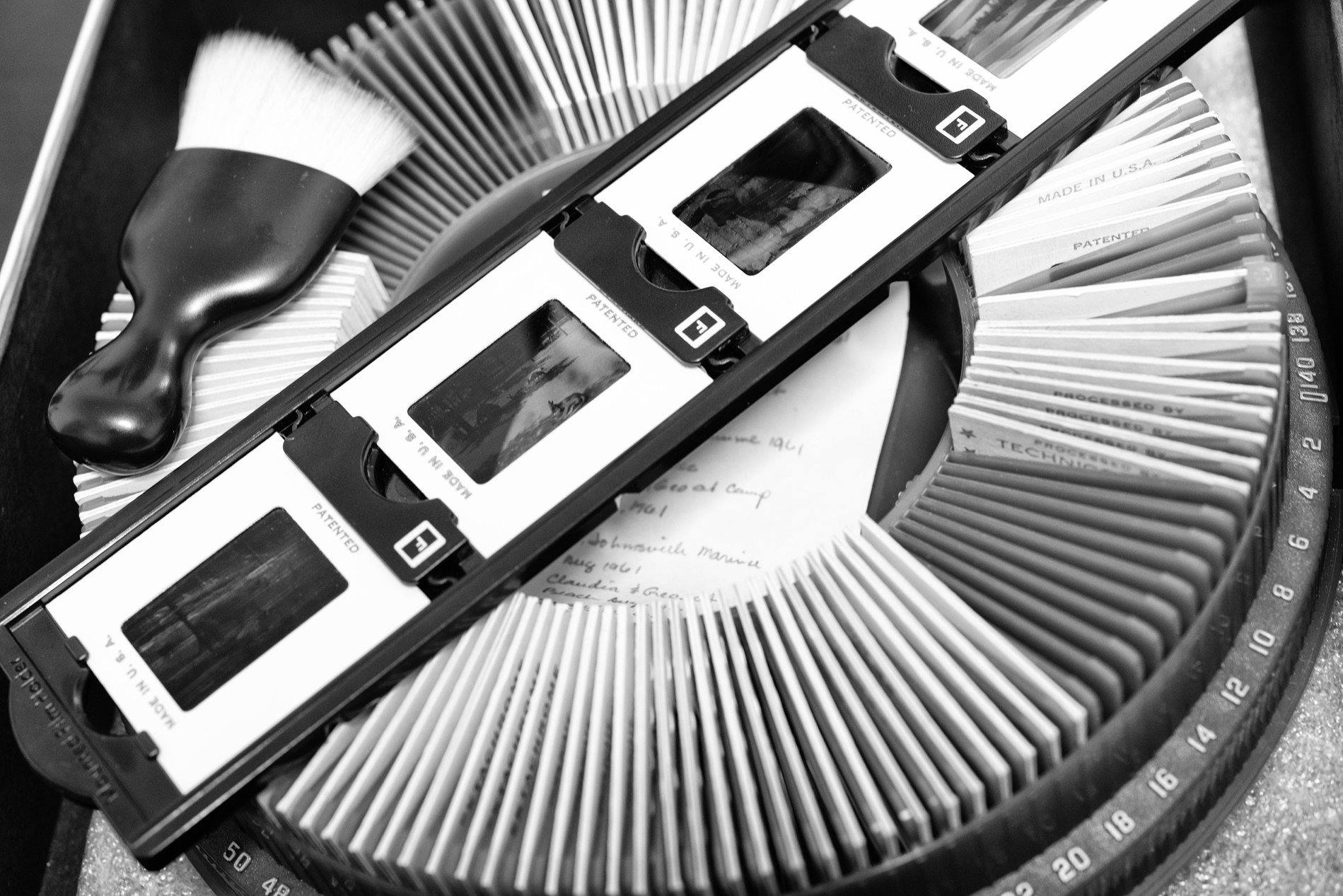
Naming files, dating mounts, figuring out who’s in the frame — that part is closer to my day job than to walking around with a camera. I don’t mind. Then I hit a slide that stopped me cold: me at about three, holding a toy camera, taking pictures of my baby sister.
Before I owned a real camera, I already had the urge. Photography was just something we did as a family. I’ve been thinking about that a lot while I scan — and about why, decades later, I still default to black and white when I walk out the door with my camera.
The Frame That Stopped the Scanner
Most of these slides are routine. Name the folder and file, dust off the slide, fix the color cast, move on. Every so often you get one that isn’t about exposure at all.
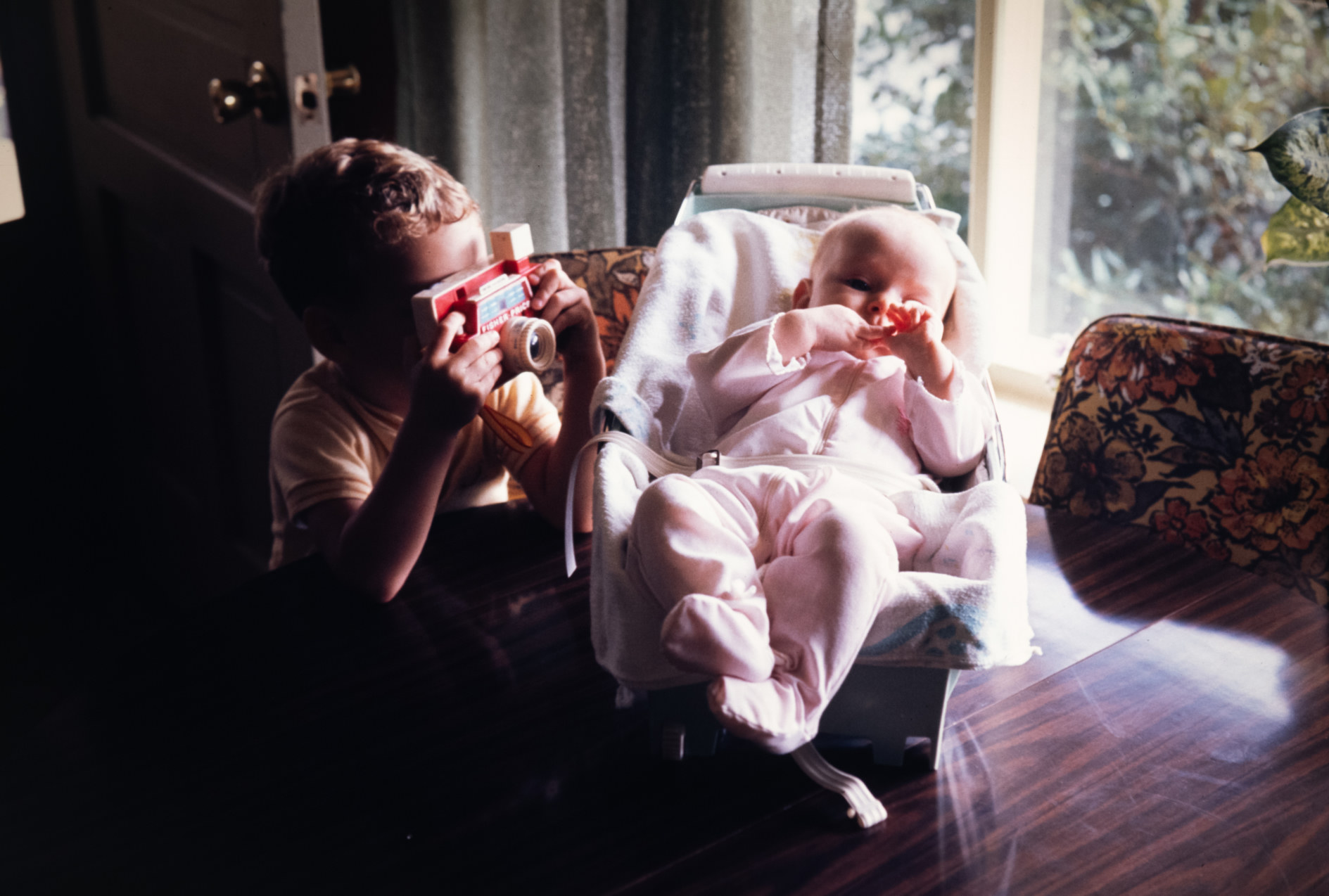
There I am at the kitchen table in the bay window, a little more than three years old, holding a red Fisher-Price toy. Window light pours across the room and hits my sister in her seat. I’m pointed right at her, the way my father pointed a real camera at all of us for years. He wasn’t teaching me anything in that frame. He was just taking a picture of the kids. Looking at it now, it’s hard not to smile.
Plenty of kids play with toy tools. But I just didn’t “discover” photography as an adult hobby. I grew up in a family where cameras were always around.
How I Learned
When my father upgraded to a Canon F1 camera, he handed down to me his well-used and well-cared-for Canon FT. For decades I shot Kodak Tri-X black and white film. In addition to teaching me about ASA/ISO, shutter speeds, and lens apertures, my Dad taught me how to develop the film I shot in our dark basement — the whole messy ritual.
You pay attention differently when a picture costs a frame of film and a chunk of your evening mixing chemicals and loading reels in the dark. You can’t undevelop a roll of bad pictures or mistakes. You learn to stop wasting frames.
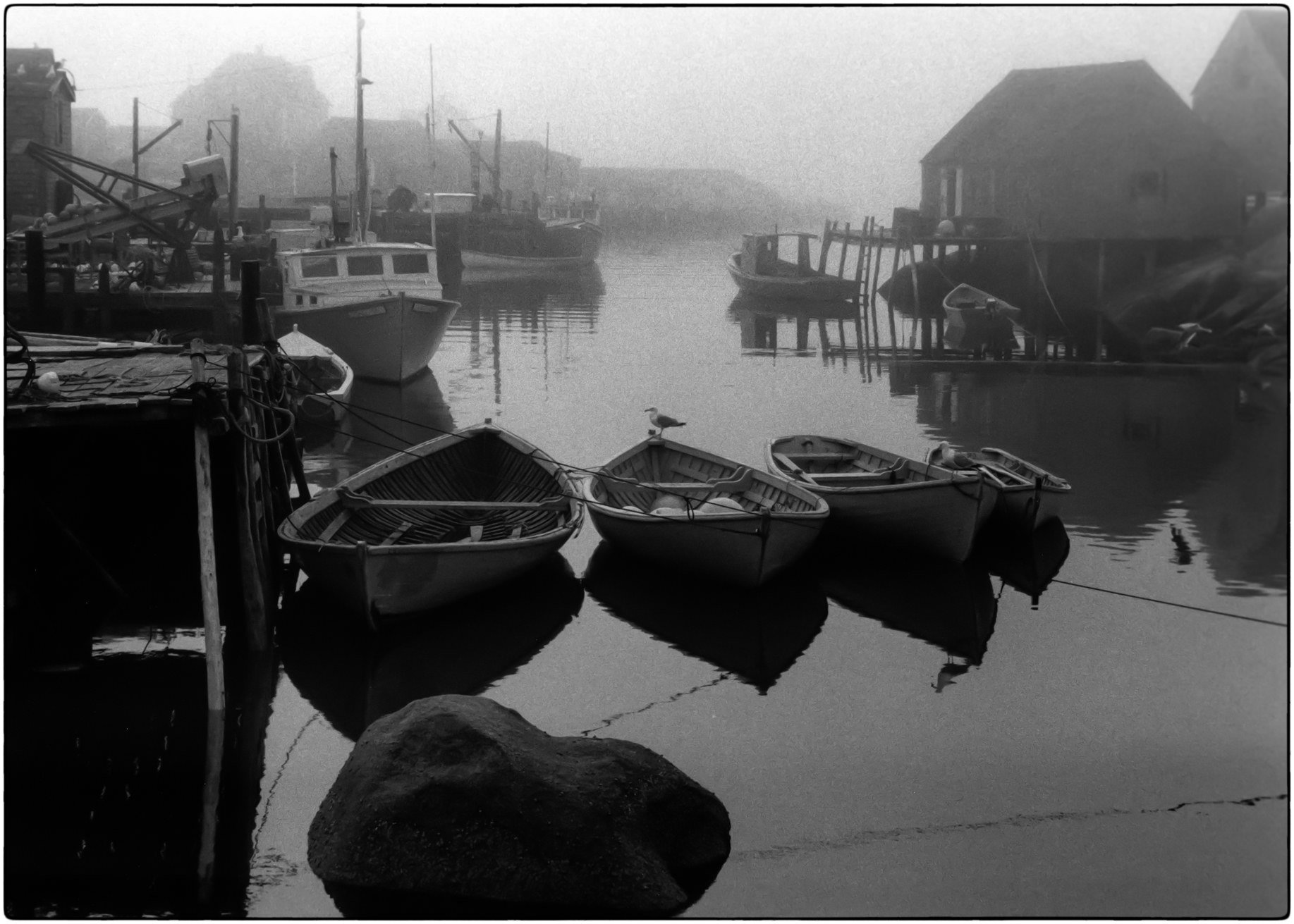
The photo above is not a digital file with a film filter slapped on it. It was shot on Tri-X with the Canon FT on a foggy morning in Nova Scotia, taken when I was about 14 — skiffs, docks, a seagull that wandered into the middle of the frame. I still really like that picture. Quiet. A little grain. Nothing fancy.
What I Shoot Now
Most of what I post on @smh.fotografie is black-and-white street and travel work — Florida when I’m home, other places when I’m traveling. The subjects change. The way I look at them doesn’t change much.
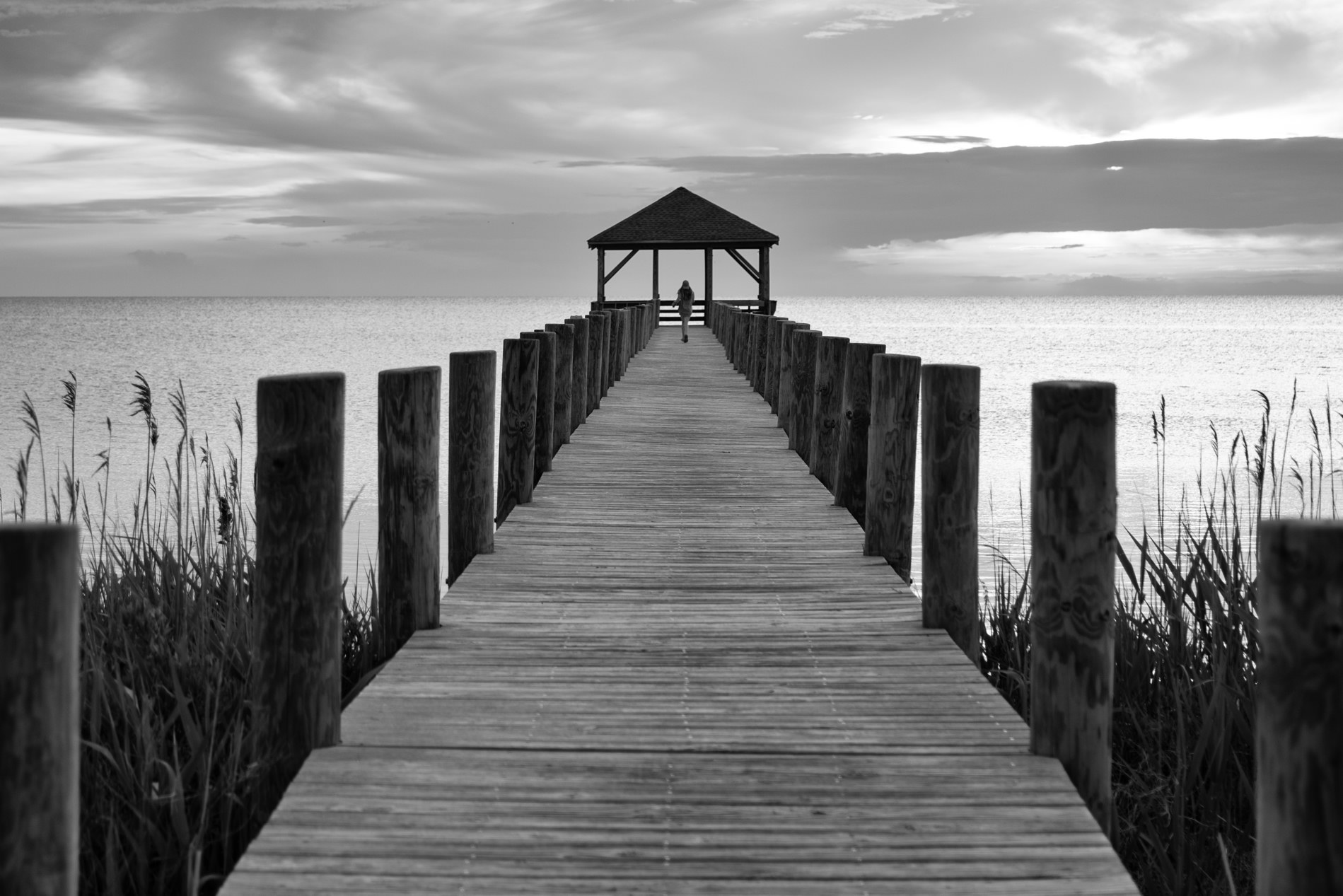
I like strong lines — a pier shooting out toward a pavilion, a long hallway, anything that pulls your eye through the frame. I like people doing something, not posing for me: someone walking the boards, a kid in a hotel window looking at the world outside while another sits on the bed with a tablet escaping that world, a street musician between songs. I don’t overthink it. I just know when a frame feels right.
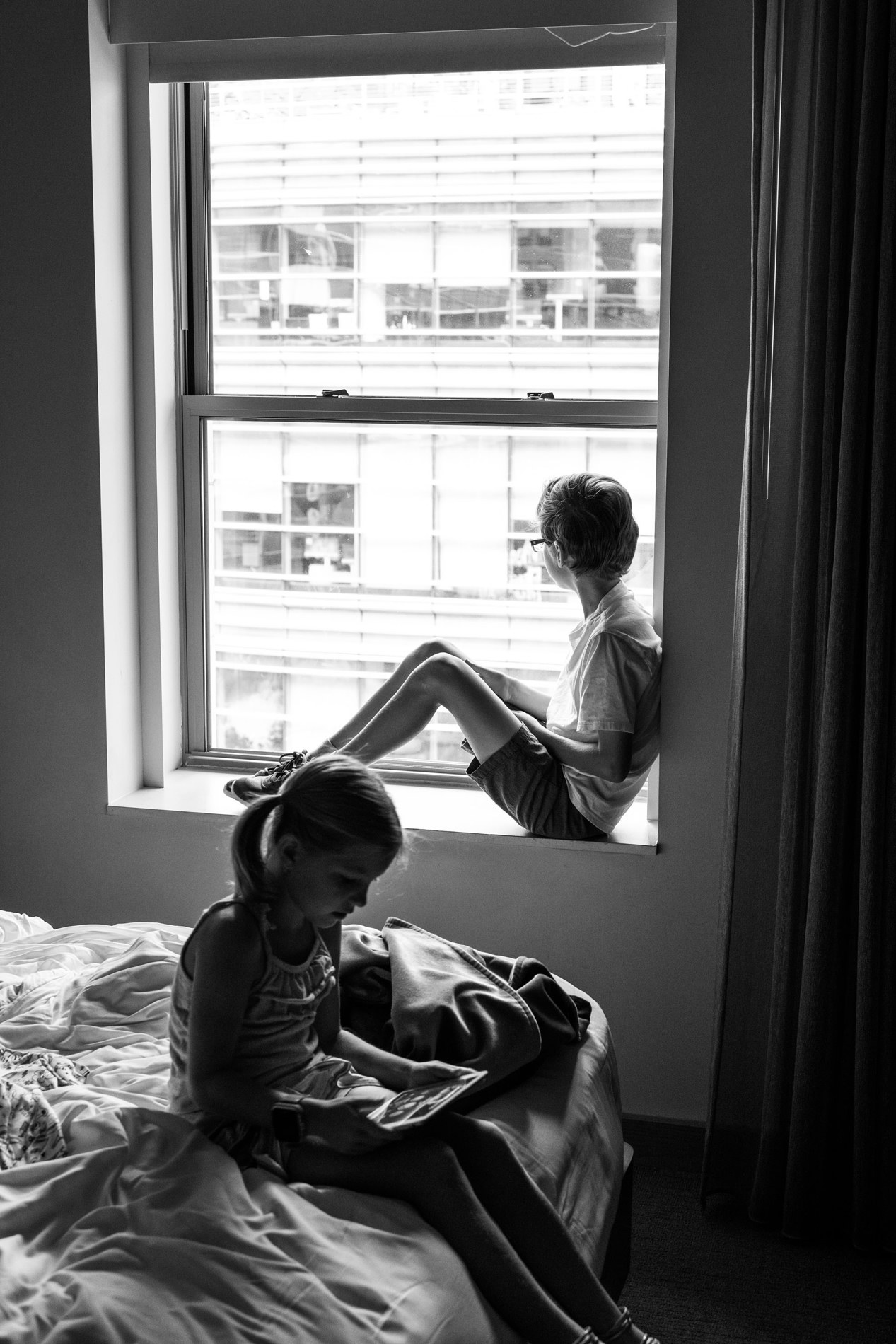
If a picture needs a long explanation, it probably wasn’t that good to begin with.
Why Black and White
Most of the time I’ve got my iPhone on me — The Best Camera Is The One That’s With You — but when I’m carrying the Leica, that’s usually what I mean to use for serious work, and the phone goes back to maps and messages.
Florida light is hard. High sun, humidity haze, colors that go loud and cheap by noon. Black and white handles that better for me. Trees read as shape. Water as brightness. Shade actually looks like shade. Busy streets have the same problem in reverse: too much neon, too many signs. Take the color out and you can see what’s going on again.
That doesn’t mean I never shoot color. Family pictures stay in color a lot of the time — iPhone and Leica both. Kids, trips, the ordinary stuff you want to remember the way it looked. Dad’s slides are decades of that same job in Kodachrome and Ektachrome. I’m still doing a version of it.
What I keep coming back to is black and white when I sit down to process. Files from a walk or a trip — pier, street, hotel window, fogged-in harbor — often look finished to me only after the color is gone. The clutter drops out. You can see the lines and the people more clearly.
There’s also how it feels, not just how it looks. Color can be noisy. A red shirt, a blue sky, and a green sign all yelling at once. Black and white quiets that down. You notice faces and small gestures more. A hotel room or a fogged harbor can feel heavier without a rainbow fighting for attention. That’s often what I’m after when I process a photo: not a filter, a different way of seeing.
When I Keep Color
Sometimes a frame needs the color because the light is the subject, not a backdrop.

A kid on a board at sunset on the Gulf is the easy local example. Convert that to black and white and you might still have a decent silhouette, but you’ve thrown out the reason you stopped walking. The warmth is the shot. I don’t post those often on purpose. Color is the exception. Black and white is the default.
Why a Leica
These days I shoot a Leica rangefinder because it slows me down. You can’t spray a hundred frames the way you can with a smart phone and hope one lands. You compose, focus, wait. You miss shots. You also come home with fewer files you never should have made. Same lesson as the basement darkroom.
The rangefinder doesn’t make better pictures. It makes me take fewer bad ones.
Still Figuring It Out
Famous places are easy. The pictures I care about more are usually quieter — a dock on the Outer Banks, a hotel room, a fogged-in harbor from forty years ago. Scanning is part of it too. I try not to invent what isn’t on the film, keep the files organized, and hang on to the ones that matter. The toy-camera photograph didn’t need heavy processing. It needed to be found, cleaned up enough to see clearly, and kept.
The work lives on smhfotografie.com now — gallery, notes, and pieces like this — not only on Instagram. The slides keep coming through the scanner, and I still walk out with a camera when I can.
The Bottom Line
Black and white isn’t a filter I picked up on a phone. It’s how I learned — hand-me-down Canon camera, Tri-X film — and still how a lot of my pictures end up looking finished to me. Dad’s archive is mostly color. Mine is mostly not, except when family or light needs color. I still like making pictures. That hasn’t changed since the Fisher-Price.
My dad’s slideshows are available online for friends and family. Send an email to steve@thehaneys.net to obtain the password.